

Why Tactile Learning Matters More Than Ever
- By Delaney Wiltermood
- Dec 9, 2025
Exploring Montessori Materials: Building the Foundation for Lifelong Learning
The name “Montessori” is familiar to many, often associated with early childhood education. Numerous homeschool programs and classroom teachers draw inspiration from the Montessori philosophy, particularly during a child’s formative years from preschool through early elementary. What many people don’t realize, however, is that Montessori principles apply from birth to young adulthood.
So, what is the Montessori philosophy, and why do so many educators embrace it? At its core, Montessori emphasizes child-centered learning, allowing children to explore and progress at their own pace within a carefully prepared environment. This approach nurtures independence, curiosity, and hands-on experiences, supporting the development of the whole child academically, socially, and emotionally.
A key component of the Montessori method is its focus on purposeful, tactile learning, especially during the First Plane of Development (ages 0–6). During this stage, children possess what Maria Montessori called the “Absorbent Mind,” an extraordinary ability to absorb information from their surroundings. Learning at this age revolves around order, concentration, repetition, and precision. Foundational concepts, such as math, are best introduced through concrete materials and manipulatives, laying the groundwork for deeper understanding later on.
One of the most distinctive features of Montessori classrooms is the use of manipulatives, carefully crafted materials that turn abstract concepts into concrete experiences. These tools support learning through key characteristics that guide their design and use.
- Concrete to Abstract: They guide children from hands-on exploration to abstract thinking.
- Multi-Sensory Engagement: By involving touch, sight, and movement, they deepen understanding.
- Physical Skill Development: Manipulating materials builds fine motor skills, coordination, and focus.
- Natural Materials and Aesthetic Appeal: Often made from wood or glass, they are durable and visually engaging.
- Purposeful Design and Progression: Each material teaches a specific concept and builds on prior knowledge without added distractions.
- Repetition and Reinforcement: Repeated use strengthens the connection between physical objects and abstract ideas.
These characteristics make learning not only effective, but also joyful and meaningful by fostering order, concentration, repetition, and precision in every hands-on manipulative.
How Didax Materials Support Hands-on Learning in Classrooms
Montessori education emphasizes hands-on learning, purposeful activity, and materials that progress from concrete to abstract. Didax offers a wide range of manipulatives that align beautifully with these principles, helping educators create rich, tactile learning experiences across developmental stages.
Here are some examples of Didax materials and how they can be integrated into Montessori-inspired classrooms:
PreK–K: Attribute Buttons
Watch: A guide to Attribute Buttons with Laces
These colorful buttons are perfect for early learners to explore counting, patterns, sorting, and classification, while also strengthening fine motor skills through lacing activities.
Montessori Connection: Encourages order and repetition, key elements of the Absorbent Mind stage.
Extension Idea: Pair with our sorting bowls and numeral cards to create engaging classification exercises that build concentration and independence.
Grades 1–2: Interlocking Base Ten Blocks & 4-Value Whole Numbers Place Value Cards Sets
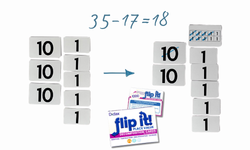
Building numbers with base-ten blocks and labeling their digits with the corresponding values helps children concretely understand place value before moving to abstract notations.
Montessori Connection: Supports the progression from concrete to pictorial to abstract and reinforces mathematical precision.
Extension Idea: Compare two numbers using place value understanding.
Grades 3–5: Fraction Tiles with Work Tray
Fraction tiles provide a hands-on approach to learning fractions, making abstract concepts tangible.
Montessori Connection: Builds on prior knowledge of part-whole relationships in composed shapes; also encourages repetition for mastery when students build and compare various fractions.
Extension Idea: Use tiles to add and subtract fractions, promoting logical thinking and problem-solving.
Grades 6–8: Integer Beaded Number Line Set
Watch: Integer Beaded Number Line with Dr. Alison Mello
This manipulative offers a visual and tactile way to explore positive and negative integers, supporting abstract reasoning through concrete representation.
Montessori Connection: Encourages precision by manipulating the beads to represent numbers and progressive learning from hands-on engagement to more abstract models, such as a number line.
Extension Idea: Incorporate activities for integer operations (addition, subtraction, and beyond) to strengthen conceptual understanding, or put two integer beaded Number Line Sets together to create a coordinate grid!
Bringing It All Together
Montessori principles like child-centered learning, moving from concrete to abstract, and using multi-sensory experiences have become time-tested strategies for every classroom. These ideas help build independence, encourage repetition for mastery, and support the whole child, academically and emotionally. Didax manipulatives make it easy to bring these concepts to life with hands-on materials that turn abstract ideas into meaningful learning. Whether you follow Montessori closely or want to make your lessons more engaging, these approaches can make learning joyful, purposeful, and effective for every student.




 © 2025 Didax, Inc. All Rights Reserved.