Receive FREE SHIPPING on orders over $99 placed on the Didax website and shipped within the contiguous US. No promo code is required to receive this offer.
The order total for free shipping is calculated after any discounts are applied. Orders containing any Eureka Math, Big Ideas, Zearn, Math Perspectives, Didax Classroom and/or Investigations Kits DO NOT qualify for free shipping.
Free shipping valid ONLY on orders placed on the Didax website shipped within the contiguous US. Our regular shipping policies applies to other orders.
Receive FREE SHIPPING on orders over $99 placed on the Didax website and shipped within the contiguous US. No promo code is required to receive this offer.
The order total for free shipping is calculated after any discounts are applied. Orders containing Eureka Math Kits DO NOT qualify for free shipping.
Free shipping valid ONLY on orders placed on the Didax website shipped within the contiguous US. Our regular shipping policies applies to other orders.
Need new ideas? Looking for quick tips for teaching tricky concepts or organizing your math centers? Class Ideas is your go-to spot for inspiration, information and innovation and it’s an ideal way to stay current with the latest trends in math teaching and learning.
Share Your Ideas with Us
If there are topics you’d like us to cover or you’d be interested in being a guest contributor, reach out to us and we’ll respond. Email us at hello@didax.com
Pre-K – grade 1 educators know all too well the importance of math in the early years and research confirms, “Children’s early mathematical knowledge serves as a predictor of later mathematics success and their college and career opportunities.” (Shah et al. 2018; Watts et al. 2014).
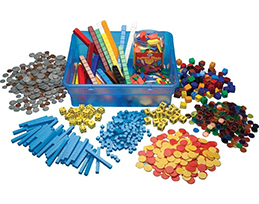
Teachers have long relied on manipulatives to introduce new math and literacy concepts and enhance learning. Manipulatives are useful at all grade levels, from kindergarten (think Unifix Cubes) through high school (think algebra tiles), with students of all abilities, including and especially those with special needs and learning differences.
Jumbo Unifix® Cubes, sandpaper letters and numerals, and Omnifix cubes are just a few of the go-to resources used in many SpEd classrooms throughout the country.
As summer break draws to a close across the country, many teachers are using these last few weeks to get their classrooms organized and ready for the start of school. Perhaps you’re changing grades or schools, or just trying something new this year. You might even be sticking with a proven format for your classroom. Whatever your situation, getting ready for school to start is a lot of work!
As the school year draws to a close, many teachers a thinking about packing up their classroom. Whether you’re staying in the same room and want things ready for the fall or moving to another grade or another school, keeping things neat and organized will help get the next year off to a good start.
Many years ago, I was introduced to the elements of early Reading instruction. With my background in math, I had a lot of learning to do, but I immediately saw the value in helping students build an understanding of phonics and phonemic awareness. Using hands-on tools like Unifix® CVC and Blends cubes can accelerate students’ understanding of these critical early reading skills. Together with the new Early Phonics and Phonics activity books, these resources allow students to make concrete connections to the words around them. I’ve selected just a couple of the 211 activities available in these two books to get you started with this resource. All these activities are designed to support small-group phonics instruction using the Unifix phonics cubes and Word-Building Cards.
Success in school, the workplace, and society increasingly depends on our ability to comprehend informational text. Yet, despite current language arts standards, informational text often gets short shrift in primary grades classrooms. One study of 20 first-grade classrooms showed that nonfiction books constituted less than 10 percent of the classroom library and that students spent less than four minutes per day reading informational text. (Duke, 2000)






 © 2025 Didax, Inc. All Rights Reserved.