
Making Place Value Visible
- By Nichole Fillman
- May 5, 2026
Making Place Value Visible
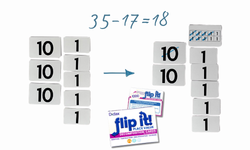
Helping students truly understand place value is more than just getting the right answer; it’s about seeing how numbers work. Without a strong foundation, even familiar operations can become confusing. Author Nichole Fillman explores how making place value more visible through structured, visual models can support deeper understanding and more confident problem-solving in elementary math.
- Common challenges students face when learning place value
- How visual, structured models support base-ten understanding and reduce cognitive load
- Classroom-ready strategies for composing, decomposing, and reasoning about numbers
The Story Behind Flip It! Place Value Decomposition Cards
Throughout my 24 years in the classroom, I’ve watched students struggle with foundational place value concepts and applying that understanding to operations. I’ve realized it’s rarely because they can’t understand it, but because they can’t see it. Place value, one of the most foundational concepts in elementary math, quietly shapes whether students develop confidence or confusion in the years that follow. Many students can follow the steps of an algorithm during regrouping, for example, but if they lack place value understanding, math becomes a process to memorize rather than a system to reason through.
Rethinking How Students See Place Value
Base-ten blocks are a powerful and important tool for building early place value understanding. I have used them extensively in my own classroom to help students develop a concrete sense of quantity and equivalence. As students moved into more complex operations, however, I began to notice that some struggled not with the math itself, but with managing the materials. During subtraction with regrouping, for example, students would carefully trade a ten for ten ones, but the physical handling of multiple pieces sometimes made it harder to maintain focus on the structure of the problem. The cognitive load of managing loose pieces sometimes overshadowed the math itself.
By reducing the cognitive load of loose manipulatives and miscounted pieces, place value cards allow students to focus on structure - understanding that ten of one unit equals one of the next larger units. This foundational understanding supports addition, subtraction, multiplication, division, and long-term confidence with numbers.
I wanted a tool that preserved the conceptual power of concrete models while offering a more streamlined, visually structured representation as they transitioned toward greater independence and abstraction. That’s how my two-sided Place Value Flip It! Cards were born.
Designed for students in kindergarten through 4th grade, each card represents a place value on the front — a Ten, a Hundred, a Thousand — and visually decomposes into units on the back using ten-frames.
- A Ten is shown as ten Ones
- A Hundred is shown as ten Tens
- A Thousand is shown as ten Hundreds
The ten-frame design was a deliberate choice because the structure is already embedded in their mathematical thinking from earlier math experiences. Using this familiar visual model supports continuity across grade levels and reinforces the idea that our base-ten system is built on groups of ten.
Students can “slide” and flip the cards, making regrouping visible, decomposition structured, and subtraction logical rather than procedural. Multiplication, division, and multi-digit operations also become more accessible because students can see the structure of numbers at a glance. The cards help reduce errors, strengthen reasoning, and build confidence in learners across the spectrum — from those who struggle to those ready for deeper thinking.
The Research Behind the Cards
The design of these cards aligns closely with research-based best practices in math instruction. For example, the cards support the Concrete–Representational–Abstract (CRA) progression. When students are ready, they bridge concrete place value tools such as cubes, blocks, and disks to representational and pictorial models. The cards are intentionally sized to visually reflect their place value, with larger units represented by larger cards. This physical design reinforces the structure of our base-ten system and helps students easily see and feel the relationship between units. When students flip a Ten card and see ten Ones, they engage with a structured visual model that makes equivalence explicit. Over time, this visual experience supports their transition to more abstract notations.
Research also emphasizes conceptual understanding of preceding and supporting procedural skills. When students model numbers, decompose units, and reason about place value relationships, they build mental structures that make more complex concepts and skills accessible and meaningful.
Research on mathematical proficiency affirms that procedural fluency develops from conceptual understanding. When students “slide a ten” and visibly decompose numbers, they are reasoning about quantity and structure rather than simply following a memorized algorithm.
Classroom Activities to Make Place Value Visible
Hands-on activities that help students see and explore place value, making math more visible and understandable.
Expanded Form
Students use place value cards to represent a number and write it in both standard and expanded form. Emphasize that a digit’s value changes depending on its position, connecting the physical cards to symbolic notation.
Comparing Numbers
In pairs, students use cards to represent two numbers and decide which is greater or smaller. They justify their thinking based on place value, not just digit size, and discuss how the structure of numbers affects value.
Composing & Decomposing
Students represent a number in multiple ways using different combinations of cards. They explain how decomposing a unit creates equivalent representations, such as trading one hundred for ten tens. Groups discuss why all models represent the same number and identify the standard form as the most efficient representation.
Base-Ten Connections
Students explore numbers with repeated digits to see how the same digit can have different values depending on its place. They compare values and explain why a digit in one place is ten times the value of the same digit to its right.
10 / 100 / 1000 More or Less
Students represent a number and then adjust it by adding or removing cards to show 10, 100, or 1000 more or less. As numbers change, they compose or decompose units to maintain accurate representations.
Addition
Students model addition problems by arranging cards by place value. Starting in the ones place, they combine cards and regroup when a column reaches ten or more units. Sliding and composing cards helps students see why regrouping works.
Subtraction
Students represent subtraction problems by removing cards according to place value. If there aren’t enough units in a place, they decompose a higher-value card to continue. Flipping and sliding cards makes regrouping visible and logical.
Multiplication – Area Model Products
Students build an area model using place value cards to represent a multiplication problem. They find partial products by multiplying each place value and recording results with cards. Students then combine like units and regroup as needed to find the total product.
Division – Partial Quotients
Students represent the dividend with place value cards and divide the value into equal groups. If a unit cannot be shared evenly, they decompose it into smaller units and continue dividing. Combining the cards in each share helps students understand division as fair sharing and repeated regrouping.
When Place Value Becomes Clear
Place value begins to make sense in a lasting way when students can clearly see how numbers are built and how units relate to one another. Instead of relying on memorized steps, they are able to reason, make connections, and approach problems with confidence.
Providing structured, visual models can help bridge the gap between concrete understanding and abstract thinking, giving students the tools they need to build strong, flexible number sense over time.
After decades in the classroom, I’ve learned that the best instructional tools are born from real student need — and that’s exactly what these two-sided place value cards do: they make math visible, logical, and truly understandable.
Explore the featured resource. Also available as a classroom set:
Flip It! Place Value Decomposition Cards
Place Value Flip Decomposition Cards, set of 10 - Bulk-Pricing
Nichole Fillman is an elementary educator with 24 years of classroom experience, including 10 years focused exclusively on teaching mathematics in third grade. She has worked with students across the learning spectrum, helping them build conceptual understanding and confidence in math. Nichole created the two-sided Flip It! Place Value Decomposition Cards to make math visible, intuitive, and error-resistant, supporting students as they develop a deep understanding of place value and multi-digit operations. Her work bridges research-based practices with practical classroom solutions, giving teachers tools to support every learner.



 © 2025 Didax, Inc. All Rights Reserved.