Receive FREE SHIPPING on orders over $99 placed on the Didax website and shipped within the contiguous US. No promo code is required to receive this offer.
The order total for free shipping is calculated after any discounts are applied. Orders containing any Eureka Math, Big Ideas, Zearn, Math Perspectives, Didax Classroom and/or Investigations Kits DO NOT qualify for free shipping.
Free shipping valid ONLY on orders placed on the Didax website shipped within the contiguous US. Our regular shipping policies applies to other orders.
Receive FREE SHIPPING on orders over $99 placed on the Didax website and shipped within the contiguous US. No promo code is required to receive this offer.
The order total for free shipping is calculated after any discounts are applied. Orders containing Eureka Math Kits DO NOT qualify for free shipping.
Free shipping valid ONLY on orders placed on the Didax website shipped within the contiguous US. Our regular shipping policies applies to other orders.
Need new ideas? Looking for quick tips for teaching tricky concepts or organizing your math centers? Class Ideas is your go-to spot for inspiration, information and innovation and it’s an ideal way to stay current with the latest trends in math teaching and learning.
Share Your Ideas with Us
If there are topics you’d like us to cover or you’d be interested in being a guest contributor, reach out to us and we’ll respond. Email us at hello@didax.com
Every spring, millions of people turn their attention to what is, mathematically speaking, a tree diagram. Some think about it only when their favorite team is playing, while others are completely immersed in the annual College Basketball tradition known as “March Madness.” This frenzied tournament provides multiple opportunities to engage students in math, although we sometimes focus so narrowly on probability and statistics that students miss out on other opportunities to learn. In the spirit of the season, we’d like to share some ideas for teachers of all levels to bring March Mathness to the classroom. You can use the link below to access the activity sheets to use in your classroom. A printable tournament bracket is available here.
Watching my children and students work with manipulatives, I can see how hands-on experiences with math concepts help build a solid foundation for future learning. Often, teachers and students struggle with the transition from concrete manipulatives to a representation of the concept. Web- or app-based “virtual” manipulatives help to make this transition easier, although many teachers struggle to find a place for these tools in the classroom. Hands-on manipulatives are an excellent tool on their own, and they are even more powerful when coupled with virtual manipulatives. To support the use of these virtual tools, Didax has developed more than a dozen free virtual resources, available on our website. If you need some help getting started, read on for some ideas!
Mathematics educators have recently highlighted the need for “low floor, high ceiling” tasks that lead students into rich areas of inquiry. The “Four 4’s” problem is a fairly well-known example cited by Jo Boaler and others, but such challenges are hard to develop. It is often difficult to find an exercise, game, or a puzzle that is instantly accessible at a basic level, yet also leads to the exploration of higher-order thinking and deeper mathematical insights. The PEMDice game is designed to scratch this itch. Very simple in concept and, when played in its elementary form, it is ultimately as complex and as challenging as anyone cares to make it.
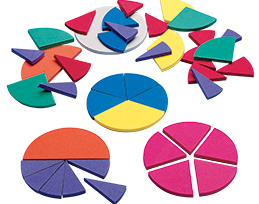
When I was teaching in the high school, we taught a unit on rational expressions and equations. In simple terms a rational expression is a fraction that has numbers and variables in the numerator, denominator, or both. Because rational expressions behave a lot like fractions, I usually started this unit with a day or two of review of fractions to help students build confidence with this foundational concept. Every year, I was surprised how many students struggled with fraction concepts, and it was clear to me that we needed to do more to build their conceptual understanding in the early grades. Generally, we are doing better with this, using more and different models to help students really understand the relationships between the part and the whole and also between fractions. Number lines help build conceptual understanding of fraction relationships and area models are useful tools for both relationships and operations. Another tool that helps students build an understanding of both fraction relationships and operations are interlocking fraction circles. The short video below explains how these circles support students’ understanding of fractions.
As a teacher for over 15 years, I recognize that the kinds of experiences that teachers offer their students play a major role in determining the extent and quality of students’ learning. For example, rich problem-solving activities help students build understanding by actively engaging in tasks and experiences designed to deepen and connect their knowledge. Playing math games affords students the opportunity to build understanding while encouraging strategic thinking as students will have different approaches for solving problems. Using classroom activities and games is also a great way to check in on their progress as well as to provide reinforcement of key concepts. I like problem-solving activities that are easy to put together, fun, and require all students to participate.
I taught an Algebra 1 or Algebra 2 class every year I was teaching, and I was always looking for ways to make the content engaging for the students. I firmly subscribe to John Van de Walle’s notion that drill and practice are two very different things, and sought opportunities for the students to have meaningful practice with the concepts they were learning. As a result, I avoided the lengthy problem sets and worksheets that are prolific in high school math classes, opting instead for problems, explorations, and games that encouraged thinking and discussion.
Every year around this time, my family is getting ready for back-to-school night. Now that I have children in high school, junior high, and elementary school, it’s always fun to see how this event is handled at the different levels. When I was teaching high school, we were very structured, with parents moving from class to class as though on a regular schedule; I think we had each group for ten minutes, just long enough to quickly review the syllabus and policies and send them off to the next class. Regardless of the structure of back-to-school night at your school, there are a few things you can do to make the evening more engaging for students and their parents. A good place to start is having some manipulatives you’ll be using during the year out for parents to handle. Things like Unifix Cubes, Pattern Blocks, Ten-Frame Floor Mats and Fraction Tiles are always good choices.
One of the things I really enjoyed about my Geometry classes in college was that they were very hands-on. We used a variety of manipulatives to explore geometric concepts, and the lessons have stayed with me for a long time now. I carried many of these ideas into the classroom when I started teaching, using ideas as simple as nets and tools like marshmallows and toothpicks. While these models are adequate for teaching the general ideas, they lack the consistency and formality that Geofix shapes offer.
When working with math teachers at any level, one of the complaints I've heard over and over begins with the phrase, "If they only knew their facts..." Fluency with basic facts, however, is only one part of a bigger picture, and I always encouraged teachers to think about the conceptual foundation they were building rather than how quickly students can rattle off some facts. As we consider the increased emphasis on rigor, we need to keep in the back of our minds what rigor is: a balance between conceptual understanding, application, and procedural fluency.






 © 2025 Didax, Inc. All Rights Reserved.