
The Tool That Finally Makes Trig Click
- By Brady Richter
- Jun 1, 2026
The Tool That Finally Makes Trig Click
By Brady Richter, Founder of Trigonometer LLC
Ask almost any math teacher about trigonometry, and you’ll hear some version of the same story. Students can memorize trig formulas: SOH-CAH-TOA. They can pass a quiz on it. But come November, when the unit circle appears in its full glory (six trig ratios, four quadrants, radian measures, and a whole lot of special angles), something goes wrong. The formulas blur together. The signs flip in mysterious ways. And the student who felt confident in September is suddenly lost.
That gap between memorization and understanding is exactly what the Trigonometer was designed to close.
What Is the Trigonometer?
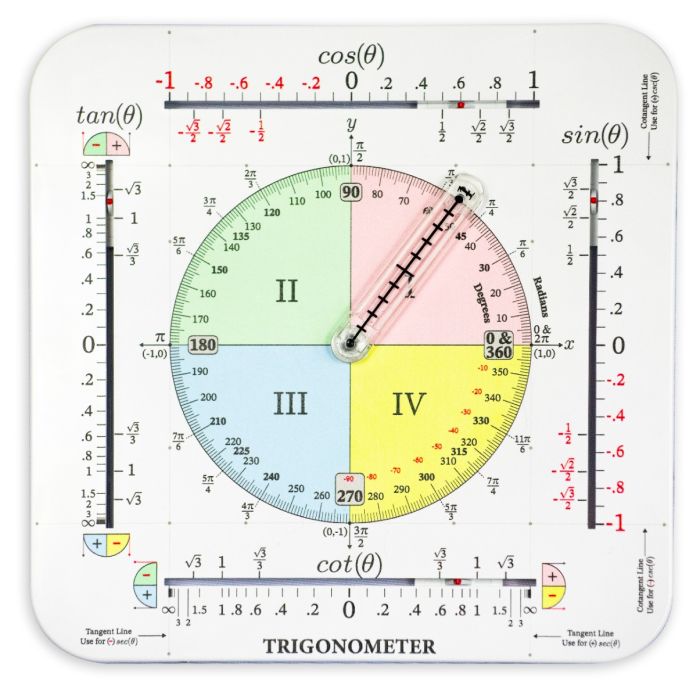
The idea behind the Trigonometer was simple: what if students could see all six ratios, in their proper geometric context, every time they needed them? What if the unit circle wasn’t something you had to reconstruct from memory, but something you could hold in your hand and explore? That’s the Trigonometer, a tool that grew out of a genuine instructional need and refined through real classroom and tutoring use.
It is a physical, slide-rule-style manipulative that lets students read all six trigonometric ratios directly from the unit circle. It’s held in the hands, rotated to any angle, and read at a glance. No calculator. No lookup table. No formula sheet required.
As a student rotates the angle arm, a mechanism on the back of the device moves sliding indicators that track the x and y coordinates of the terminal point, giving immediate physical readings for sine, cosine, tangent, and cotangent. An extender on the angle arm also stretches out to meet the lines x = +/-1 and y = +/-1, allowing students to measure the length of the secant and cosecant directly. Students don’t just learn that secant is the reciprocal of cosine; they see its length change on the unit circle in real time as they moved through different angles. That’s a geometric intuition no formula alone can build.
The design draws on the same intuition behind the classic slide rule: when you make math physical and visual, something clicks that a textbook alone cannot always reach.
Why Teachers Need This in Their Classrooms
Trigonometry sits at a crossroads in math education. It’s often the first topic where students feel the floor drop out from under them, where abstract representations multiply faster than intuition can keep up. At the same time, it’s the foundation for nearly everything that follows: precalculus, calculus, physics, engineering, and computer graphics all depend on students having a working relationship with these ratios.
The Trigonometer supports teachers in several concrete ways:
- It externalizes the unit circle. Rather than asking students to visualize an abstract diagram from memory, the Trigonometer puts that structure in their hands. This is especially powerful for visual and kinesthetic learners, and for students who struggle to hold multiple abstract relationships in working memory simultaneously.
- It makes all six ratios visible at once. Traditional instruction often treats sine, cosine, and tangent as the “big three” and leaves cosecant, secant, and cotangent as an afterthought. The Trigonometer gives all six equal real estate and demonstrates, geometrically, what each one actually means.
- It supports exploration, not just verification. Students can rotate through angles and observe how the ratios change continuously, building intuition about behavior across quadrants: where values are positive, where they’re negative, and why.
- It reduces cognitive load during problem-solving. When students aren’t spending mental energy retrieving basic values, they can focus on the actual structure of the problem in front of them.
From the Classroom
The response from educators who have used the Trigonometer tells a consistent story: students engage differently when a physical tool is in front of them. Trig stops feeling like a list of rules to memorize and begins to feel like a structure to explore.
“When my students entered the room and saw the trigonometers on their tables, they gathered in amazement. They engaged immediately. I love how the trigonometer helps my students view trigonometry numerically, which frees them from having to draw right triangles every time they try to evaluate a trig function. It enables them to see numeric approximations to expressions like cos(170°) that previously would have produced blank stares.” -Neal-Roys Math Teacher
Students, too, respond to something they can hold. There’s a different quality of attention that a physical object commands, a sense that this is real and that the math it represents is real too. One student’s reaction upon picking it up for the first time said it all: “Yo, this is fire!”
A Tool Born from Tutoring
The Trigonometer didn’t come out of a product lab. It came out of years of one-on-one tutoring sessions, watching students hit the same wall in the same place. As a math and science tutor working with students on the ACT, SAT, and precalculus, I saw firsthand how a conceptual gap in trig had a way of following students, showing up months later in calculus, or on a standardized test, or in a physics course where the instructor assumed everyone already had it down.
Those experiences pointed toward a simple but important idea: students learn trigonometry differently when they can see and manipulate the relationships for themselves. The Trigonometer was built around that idea and refined through real classroom use.
Bringing It into Your Classroom
The Trigonometer is designed to work in a range of instructional settings: as a classroom set for group exploration, as an individual tool for students who need extra support, or as a resource for any learner who benefits from something concrete to hold alongside the abstract.
Trig doesn’t have to be the place where students stop trusting themselves. With the right tools, ones that make the relationships visible, tangible, and explorable, it can be the place where things finally start to make sense.
Brady Richter is an educator, a product designer, and the founder of Excellerate Tutoring. He is passionate about helping students truly understand math — not just memorize it. He's seen how powerful hands-on learning can be after having tutored more than 250 students. Combining his background in product design and mathematics education, Brady created the Trigonometer. His goal is simple: help students see how math works so concepts click faster and stick longer.
CLICK HERE to Watch & Learn More!


 © 2025 Didax, Inc. All Rights Reserved.