Receive FREE SHIPPING on orders over $99 placed on the Didax website and shipped within the contiguous US. No promo code is required to receive this offer.
The order total for free shipping is calculated after any discounts are applied. Orders containing any Eureka Math, Big Ideas, Zearn, Math Perspectives, Didax Classroom and/or Investigations Kits DO NOT qualify for free shipping.
Free shipping valid ONLY on orders placed on the Didax website shipped within the contiguous US. Our regular shipping policies applies to other orders.
Receive FREE SHIPPING on orders over $99 placed on the Didax website and shipped within the contiguous US. No promo code is required to receive this offer.
The order total for free shipping is calculated after any discounts are applied. Orders containing Eureka Math Kits DO NOT qualify for free shipping.
Free shipping valid ONLY on orders placed on the Didax website shipped within the contiguous US. Our regular shipping policies applies to other orders.
Need new ideas? Looking for quick tips for teaching tricky concepts or organizing your math centers? Class Ideas is your go-to spot for inspiration, information and innovation and it’s an ideal way to stay current with the latest trends in math teaching and learning.
Share Your Ideas with Us
If there are topics you’d like us to cover or you’d be interested in being a guest contributor, reach out to us and we’ll respond. Email us at hello@didax.com
It’s hard to believe that 2018 is here, and we’re quickly approaching the 100th day of school. When I first started working with elementary school teachers, the concept of a 100 days celebration was foreign to me—it wasn’t something that we did in high school. Over time, I’ve come to appreciate this tradition and the mathematical opportunities it brings. In honor of 100 days of learning this school year, here are a few ideas for your 100th day activities. Try them out and let us know what you think!
The Math Standards highlight number lines as a critical model to build flexibility and understanding, and we know that number lines can be used for a variety of concepts across grades. Unfortunately, students cannot interact with number lines in a way that allows them to touch and manipulate the parts the way they can with, say, Base Ten blocks or Rekenreks.
Are you looking for a new way to teach or review integer addition and subtraction with students? These hands-on activities can help students build a solid conceptual understanding of integer operations!
A few weeks ago, we shared a new tool for Unifix cubes, the corner cube. This week I wanted to introduce you to something else that’s new in the world of Unifix: the Jumbo Unifix cube. My three-year-old recently got into my box of Unifix cubes and was having a good time building with them, until I handed him the jumbo cubes. His eyes lit up and he immediately went to work with the larger cubes. Bigger than our traditional Unifix cubes, these are perfect for smaller hands in preschool and kindergarten classrooms. They are also popular with special education teachers and occupational therapists for students who are still developing their fine motor skills.
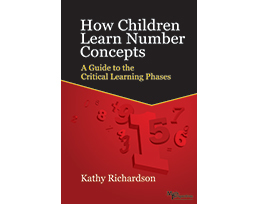
Kathy Richardson, one of the leading authorities on elementary math, has spent years educating children in the early grades. Her recent book, How Children Learn Number Concepts, is a wonderful introduction to the Critical Learning Phases that elementary children move through as they are developing a sense of number. This concise book is full of information to guide teachers of all levels as they help students through the phases.
A lack of number sense is frequently the reason given when a student is struggling with math. But what do we really mean when we say “number sense” and why are so many students struggling with it?
As the proverb claims, Slopeometer was born out of necessity. It happened when I was teaching calculus but has since proven incredibly useful in a variety of ways--from a middle-school setting on up. The inspiration came when I kept tracing along the graph of a function while I asked my AP calculus students at each point to “imagine the slope of the tangent line” as it gradually changed--from negative to zero to positive--representing the values of the “derivative” of the function. When, after some puzzled looks from my students, I said “imagine a plumb bob, always pointing to the correct value as it changes slope…” the lightbulb moment happened. Over the weekend, after a trip to a building supply store, I was able to cut a semicircle out of a piece of plexiglass and mark it with appropriate numbers and fractions, then loosely fasten a gravity-activated indicator arm that did the pointing... and presto!--the Slopeometer. My students found it much easier to picture the process, often called “curve-sketching,” and apply it to their own work. My students found it so helpful. Slopeometer has since proven useful in many areas: from “best fit” regression lines, to estimating tangent ratios, to slope-fields for differential equations--but the device has shown to be especially useful when first introducing slope.
Teachers have long relied on manipulatives to introduce new math and literacy concepts and enhance learning. Manipulatives are useful at all grade levels, from kindergarten (think Unifix Cubes) through high school (think algebra tiles), with students of all abilities, including and especially those with special needs and learning differences.
Jumbo Unifix® Cubes, sandpaper letters and numerals, and Omnifix cubes are just a few of the go-to resources used in many SpEd classrooms throughout the country.
Watching my children and students work with manipulatives, I can see how hands-on experiences with math concepts help build a solid foundation for future learning. Often, teachers and students struggle with the transition from concrete manipulatives to a representation of the concept. Web- or app-based “virtual” manipulatives help to make this transition easier, although many teachers struggle to find a place for these tools in the classroom. Hands-on manipulatives are an excellent tool on their own, and they are even more powerful when coupled with virtual manipulatives. To support the use of these virtual tools, Didax has developed more than a dozen free virtual resources, available on our website. If you need some help getting started, read on for some ideas!
As summer break draws to a close across the country, many teachers are using these last few weeks to get their classrooms organized and ready for the start of school. Perhaps you’re changing grades or schools, or just trying something new this year. You might even be sticking with a proven format for your classroom. Whatever your situation, getting ready for school to start is a lot of work!






 © 2025 Didax, Inc. All Rights Reserved.