

Base Ten Blocks: Your Most Important Tool
- By Rob Madell
- May 7, 2019
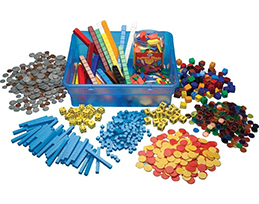
We often see children who struggle to perform even the most basic operations, even after repeated instruction. Without an understanding of base ten and place value, children are very limited in their ability to do ordinary arithmetic; that is, to add, subtract, multiply and divide. If, for example, they can only think of 48 crayons as 48 individual loose crayons, and 25 more crayons as 25 individual loose crayons, then the only strategies available for finding the total number of crayons are “counting all” (1, 2, . . ., 48, 49, 50, . . . 73) and “counting on” (48 - 49, 50, . . . , 73).
An understanding of base ten and place value makes many more efficient strategies accessible. That understanding consists of only two big ideas, each of which can be made concrete using base ten blocks and each of which is central to Working with Base Ten Blocks
- The first idea is that numerals and number names can be represented with blocks. For example, the numerals 48 and 25 and the corresponding number names “forty-eight” and “twenty-five” can be represented with 4 tens blocks and 8 ones blocks and with 2 tens blocks and 5 ones blocks.
- The second idea is that 1 tens block and 10 ones blocks are equivalent.


Children can now use these understandings to find the total number of crayons in at least 2 ways that are more efficient than counting all or counting on.
-
1. They can “base ten count” the blocks: 10, 20,… 60, 61, 62,… 73.
- 2. They can “add tens to tens, ones to ones, and exchange”: 4 tens blocks and 2 tens blocks is 6 tens blocks; 8 ones and 5 ones is 13 ones; 13 ones is 1 ten and 3 ones, so altogether I have 7 tens blocks and 3 ones blocks or 73.
In addition to these two foundational ideas, there is a third big idea that is important for children to understand. That idea is that base ten blocks—the thousand block, the hundred block, the ten block and the one block—can be represented by icons (cubes, squares, lines and dots respectively) that children can draw and use for paper and pencil computational activities. Here is what those icons look like representing the number 2,352.

Here is a simple example of how those icons are used to build understanding: Children are taught to represent 48 by drawing 4 lines and 8 dots and to represent 25 by drawing 2 lines and 5 dots and then to use their drawings to support base ten counting and adding tens to tens and ones to ones.

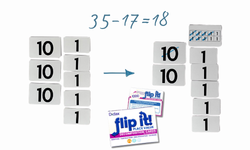
Similar activities in Working with Base Ten Blocks support this same idea with all 4 operations (addition, subtraction, multiplication and division) with 2-, 3- and 4-digit numbers. The sample worksheets below provide further examples of subtraction and division.
Base 10 Blocks- Subtraction Sample Worksheet
Base 10 Blocks- Division Sample Worksheet
Base ten blocks, and the icons that represent them, may be the most important manipulatives in support of the elementary math curriculum. They can be used to explore all four operations with whole numbers into the thousands, and they help children discover all kinds of computational strategies




 © 2025 Didax, Inc. All Rights Reserved.