

Making Algebra Click Using Manipulatives
- By Henri Picciotto
- Nov 6, 2025
Manipulatives Make Algebra Learning Concrete for Upper Levels
Every middle school math classroom presents a unique set of opportunities and challenges. Students arrive with solid arithmetic skills but often struggle as they move toward abstract ideas in algebra. When lessons begin with symbols and rules alone, many students quickly lose confidence. Hands-on learning provides a bridge, giving students something concrete to think with as they make sense of new concepts.
I co-authored There Is No One Way to Teach Math with Robin Pemantle, a mathematician at the University of Pennsylvania. Here is an excerpt from the “Manipulatives” chapter, highlighting the use of Lab Gear.
How to put Manipulatives in Practice
Algebra Lab Gear is a complete manipulative system designed for the teaching and learning of algebra. The Lab Gear (Figure 6.3) extends the model of base ten blocks by adding "variable" blocks to represent x, y, xy, x², y² and more. The models are particularly helpful for visual and kinesthetic learners as students move the blocks to represent problems in different ways. The materials are designed for use in Pre-Algebra and Algebra I courses.
Figure 6.3
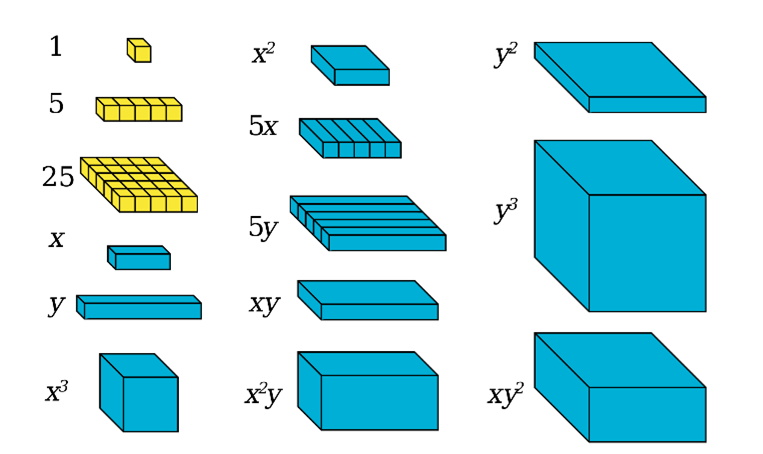
Lab Gear Rectangles
Here is a puzzle: make a rectangle, using two x2 blocks, five x blocks, and two ones. Write length × width = area for your rectangle. Figure 6.6 shows the resulting arrangement, and the corresponding symbolic representation in two formats.
Figure 6.6
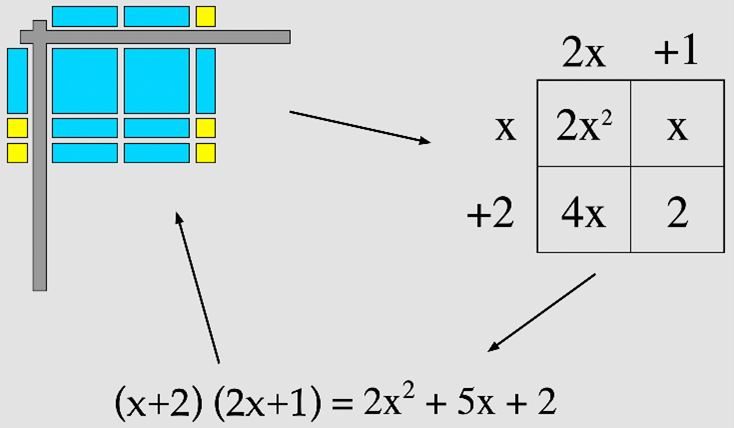
This activity is a way to take advantage of the rectangle area model of multiplication. Doing many “make a rectangle” problems of this type, and discussing them, helps lay a foundation for understanding many algebraic manipulation topics: the distributive rule, factoring, simple polynomial division, simplifying some algebraic fractions, completing the square. It is possible for all students to get involved immediately, since they know what a rectangle is. (Starting with a teacher explanation of the distributive rule or factoring would be sure to leave many students behind.) Of course, while making the rectangles provides the foundation, it is not sufficient in and of itself. Teacher-led discussions of the resulting figures are required in order for students to make sense of this.
Another, more immediate benefit is that working with this model helps students recognize the difference between x + 2, 2x, and x2 as their representations are quite different from each other. The fact that so many middle school students confuse those expressions is a symptom of how the strictly symbolic approach fails to connect.
An extension to three dimensions allows for the representation of third-degree expressions. For example, Figure 6.7 shows the Lab Gear representation of
(x+y)3(x+y)3
.
Figure 6.7

While the Lab Gear manipulatives were not originally designed for this, they also provide an engaging environment for perimeter problems, which lead to interesting basic manipulations. For example, students can be asked for the perimeter of the shape in Figure 6.8, which is made up of a 1 block and an x2 block.
Figure 6.8

One student may answer 3 + 3x + (x − 1). Another: x−1+x+x+x+1+1+1. The best way to see if the two students agree is to simplify the expressions. And yes, both simplify to 4x + 2, so they do agree. While gratuitous “simplify” problems are not popular among students, when they are debating the results of their perimeter problems, they care about the outcome and vigorously engage in debates about them.
An interesting follow-up puzzle is find other Lab Gear figures with that same 4x + 2 perimeter. Searching for those can lead to interesting discoveries and discussions.
Why Manipulatives Matter
The power of using these manipulatives is that they are, to paraphrase Papert, “objects-to-discuss” and “objects-to-write-about”, as well as “objects-to-think-with”. It is especially in the ensuing conversation among students, with guidance from the teacher, that connections are made, and underlying structures are revealed.
Didax Algebra Lab Gear products are available in both a student set and a classroom set with guides by Henri Picciotto.
Contact our sales team at sales@didax.com for school and district quotes.




 © 2025 Didax, Inc. All Rights Reserved.