Receive FREE SHIPPING on orders over $99 placed on the Didax website and shipped within the contiguous US. No promo code is required to receive this offer.
The order total for free shipping is calculated after any discounts are applied. Orders containing any Eureka Math, Big Ideas, Zearn, Math Perspectives, Didax Classroom and/or Investigations Kits DO NOT qualify for free shipping.
Free shipping valid ONLY on orders placed on the Didax website shipped within the contiguous US. Our regular shipping policies applies to other orders.
Receive FREE SHIPPING on orders over $99 placed on the Didax website and shipped within the contiguous US. No promo code is required to receive this offer.
The order total for free shipping is calculated after any discounts are applied. Orders containing Eureka Math Kits DO NOT qualify for free shipping.
Free shipping valid ONLY on orders placed on the Didax website shipped within the contiguous US. Our regular shipping policies applies to other orders.
Need new ideas? Looking for quick tips for teaching tricky concepts or organizing your math centers? Class Ideas is your go-to spot for inspiration, information and innovation and it’s an ideal way to stay current with the latest trends in math teaching and learning.
Share Your Ideas with Us
If there are topics you’d like us to cover or you’d be interested in being a guest contributor, reach out to us and we’ll respond. Email us at hello@didax.com
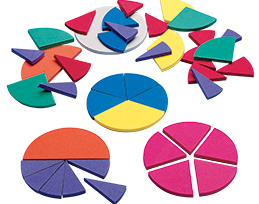
When I was teaching in the high school, we taught a unit on rational expressions and equations. In simple terms a rational expression is a fraction that has numbers and variables in the numerator, denominator, or both. Because rational expressions behave a lot like fractions, I usually started this unit with a day or two of review of fractions to help students build confidence with this foundational concept. Every year, I was surprised how many students struggled with fraction concepts, and it was clear to me that we needed to do more to build their conceptual understanding in the early grades. Generally, we are doing better with this, using more and different models to help students really understand the relationships between the part and the whole and also between fractions. Number lines help build conceptual understanding of fraction relationships and area models are useful tools for both relationships and operations. Another tool that helps students build an understanding of both fraction relationships and operations are interlocking fraction circles. The short video below explains how these circles support students’ understanding of fractions.
As I travel around the country working with teachers, I frequently hear, “My students just don’t like fractions.” Teachers are right, fractions are confusing. Let’s explore the foundational understandings and possible misconceptions that students may go through as they are learning about fractions. As articulated in the progression on “Number and Operations-Fractions, 3-5,” fractional understanding begins in Grades 1 and 2 as students partition shapes. This is certainly a logical beginning as students have had experiences identifying when their share is smaller than someone else’s! In Grade 3, students begin considering breaking a whole into equal parts. Students work with wholes that are varying shapes such as rectangles or circles and the focus is placed on equal parts. The emphasis in Grade 3 is on unit fractions (i.e., fractions having 1 as the numerator). Just as our whole numbers are composed by combining 1s, fractions can be similarly constructed by combining unit fractions. For example, ¾ = ¼ + ¼ + ¼.
As a teacher for over 15 years, I recognize that the kinds of experiences that teachers offer their students play a major role in determining the extent and quality of students’ learning. For example, rich problem-solving activities help students build understanding by actively engaging in tasks and experiences designed to deepen and connect their knowledge. Playing math games affords students the opportunity to build understanding while encouraging strategic thinking as students will have different approaches for solving problems. Using classroom activities and games is also a great way to check in on their progress as well as to provide reinforcement of key concepts. I like problem-solving activities that are easy to put together, fun, and require all students to participate.
When I was working in the school district office, we spent significant time putting together a plan that would meet the needs of a range of learners. Where there were almost an endless number of resources from which to choose for Reading, there were very few for Math. We looked at many options but struggled to put together anything as comprehensive as what we could offer for Reading. It was during this struggle that I was introduced to the work of Kathy Richardson, who is one of the leading math educators in the country. As I studied Kathy’s work, I came to understand that the very foundational concepts of number—counting, for example—were much more complex than I had given them credit for. As I became familiar with the Critical Learning Phases that Kathy identified, I realized just how important it is for students to build their conceptual understanding of number relationships.
I taught an Algebra 1 or Algebra 2 class every year I was teaching, and I was always looking for ways to make the content engaging for the students. I firmly subscribe to John Van de Walle’s notion that drill and practice are two very different things, and sought opportunities for the students to have meaningful practice with the concepts they were learning. As a result, I avoided the lengthy problem sets and worksheets that are prolific in high school math classes, opting instead for problems, explorations, and games that encouraged thinking and discussion.
Every year around this time, my family is getting ready for back-to-school night. Now that I have children in high school, junior high, and elementary school, it’s always fun to see how this event is handled at the different levels. When I was teaching high school, we were very structured, with parents moving from class to class as though on a regular schedule; I think we had each group for ten minutes, just long enough to quickly review the syllabus and policies and send them off to the next class. Regardless of the structure of back-to-school night at your school, there are a few things you can do to make the evening more engaging for students and their parents. A good place to start is having some manipulatives you’ll be using during the year out for parents to handle. Things like Unifix Cubes, Pattern Blocks, Ten-Frame Floor Mats and Fraction Tiles are always good choices.
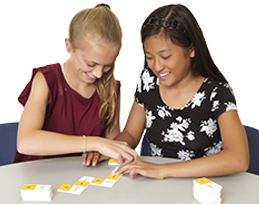
Traditional dominoes have a variety of uses in the classroom. A simple internet search for “math domino games” yields thousands of ideas for using these tools to build number concepts. But eventually, the novelty wears off and they become more of a toy than a learning tool. But the matching aspect of dominoes lets us expand this teaching tool to domains beyond number.
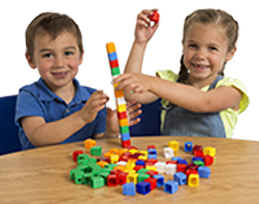
The first time I ever saw a teacher using Unifix cubes in the classroom, it was not in an elementary school. I was coaching a middle school teacher who was introducing the concepts of mean, median, and mode to her students. They were using the cubes to “graph” the data and then find these measures of central tendency. Since then, I’ve seen Unifix cubes in classrooms at every grade level, used in a variety of ways to teach number sense, data, measurement, patterns, and an array of topics. They were never as useful a tool for Geometry… until now.
One of the things I really enjoyed about my Geometry classes in college was that they were very hands-on. We used a variety of manipulatives to explore geometric concepts, and the lessons have stayed with me for a long time now. I carried many of these ideas into the classroom when I started teaching, using ideas as simple as nets and tools like marshmallows and toothpicks. While these models are adequate for teaching the general ideas, they lack the consistency and formality that Geofix shapes offer.
My Preschool-age son likes to read with us, and one of the books in his “favorites” rotation teaches shapes and colors. On the page with the rhombus, I always use the term “rhombus” rather than “diamond,” which is what is printed in the book. While reading with his mother last week, she read the term on the page rather than substituting “rhombus.” My son quickly corrected her; he shared what his preschool teacher taught him: “Diamonds are shiny things in jewelry. That is a rhombus.”






 © 2025 Didax, Inc. All Rights Reserved.